
Quiet in class! Take your seats and open your books. Lately, I've seen too many villagers fascinated by the Moriya Shrine's promises of innovation and miracles so I think it's the perfect time to tell you how that alliance was really formed before they came to Gensokyo.
In ancient history, there are no pure heroes or absolute villains; only factions willing to do whatever it takes to survive. The true story of Kanako and Suwako isn't a fairy tale, but a bloody cultural clash that ended in one of the darkest and most suffocating political agreements on record.
Centuries ago, the Yamato imperial court —the expansionist faction Kanako represents— began to expand its territory. They advanced as an unstoppable force, bringing what was cutting-edge technology at the time: Iron weapons, mirrors, and bronze bells. However, upon reaching the Suwa region, their overwhelming advance hit an unbreakable wall: the native resistance led by the god Moreya, who you know today as Suwako.
Yamato learned the hard way that they couldn't conquer the region with mere military superiority. Why? Suwako wasn't fighting alone; the land itself was under the protection of the Mishaguji. Today, many mistake them for simple "curse gods," but the truth was much deeper. They were ancient nature spirits that lived in trees and rocks, bringing life force and fertility. They represented the raw essence of nature, and the empire's swords couldn't cut the spirit of the earth.
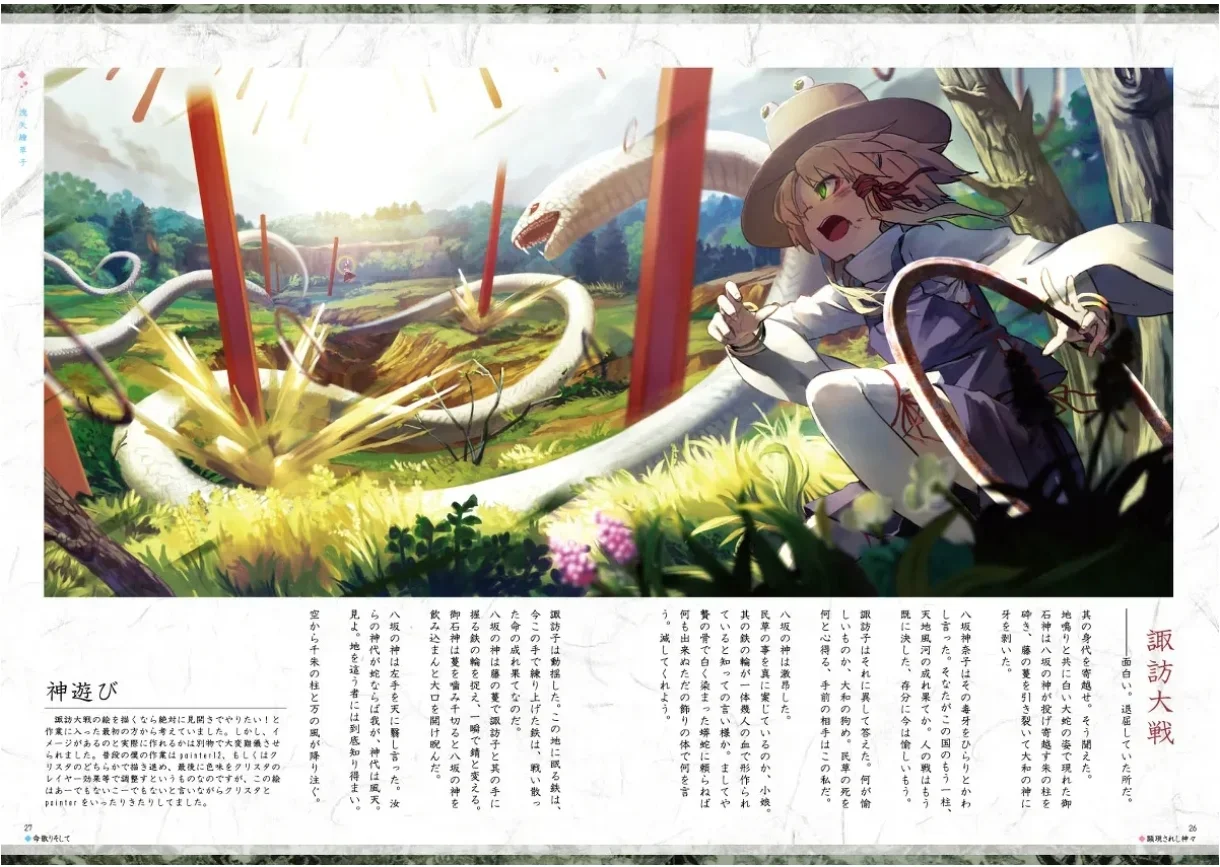
The war reached a stalemate. That's when Kanako realized wiping out the locals was impossible, so she resorted to the ultimate empire tactic: religious assimilation. Both deities sat down to negotiate, but make no mistake; this wasn't a friendly handshake. It was a mutual hostage situation. A pact built on fear.
Kanako would take the role of the main deity, absorbing the region under the civilized Yamato flag. Suwako, in return, gave up her official throne, but her bloodline—the Moriya clan—kept absolute power in the shadows.
To seal this alliance, they created the figure of the ōhōri: they chose a young boy and turned him into the living incarnation of the Suwa god, a deity of flesh and blood. Kanako put her name on the shrine's front door, yes, but Suwako's trap was brilliant: the only one with the authority to summon the fearsome Mishaguji to possess the boy was the jinchōkan, the high priest who always belonged to the Moriya family.
The Moriya controlled the weapons. And the Mishaguji did not forgive. When offended, their curses were devastating: they punished not only the offender, but their whole family and livestock. The ōhōri himself, the living god, was basically a prisoner of this pact. He was strictly forbidden from leaving Suwa; if he did, the Mishaguji's fury would fall upon him. In fact, records speak of a medieval ōhōri who made the mistake of leaving the region, fell from grace, and was driven to suicide by the anger of these spirits.
The level of immunity and authority this theological control gave them was absolute. The Suwa Shrine became a true historical anomaly compared to the rest of the country. While all of Japan followed strict religious rules that forbade harming sentient beings, the Moriya justified hunting and handed out sacred talismans and chopsticks that allowed their followers to eat deer meat in the middle of winter without suffering negative karma or spiritual pollution. That is the privilege of having the ancient spirits of the earth in your pocket.
Still, it's undeniable that as centuries passed, this tense standoff has softened. What started as a deadlock based on mutual destruction has changed over time; sharing the management of the shrine for millennia has smoothed things over between Kanako and Suwako, building a genuine friendship.
The Moriya Shrine you see today at the top of the Youkai Mountain is no longer held up by terror, but never forget its foundations.


